Biosimilar adoption and vertical integration used to be separate challenges for manufacturers — one focused on formulary competition, the other on navigating payer consolidation. New Q2 2026 MMIT Indices research suggests they’ve merged into a single prevailing pressure.
As more payers fold PBMs, specialty pharmacies, and even physician practices into their own operations, the same consolidated entities now setting formulary strategy are also the ones deciding a biosimilar’s fate. Manufacturers of biosimilars are no longer just competing against reference products. Instead, they’re competing against a payer ecosystem with more contracting power, more pricing visibility, and less patience for anything that doesn’t move the net cost needle.
For manufacturers, understanding one trend increasingly means understanding both. Let’s look at what the data reveals.
Vertical Integration Has Moved From Trend to Default
For the past two decades, vertical integration has been a growing trend, with the most recent wave of consolidation focused on payers’ acquisition of physician practices, PBMs and specialty pharmacies. According to our survey, 81% of surveyed payers report their organization has completed vertical integration efforts, with another 10% actively researching integration options. Among those that have integrated, PBM and specialty pharmacy components are universally included, while large national plans differentiate further by folding in care facilities and physician practices.
For payers, the reported benefits are substantial: 98% of integrated payers cite streamlined operations, and 97% cite lower costs as key advantages. The vast majority of integrated payers also claim better control over their supply chain as well as a slew of member-associated benefits: improved care coordination, more standardized care, better population health management, and a simplified patient experience.
Where integration is really changing the game is in contract execution. Most integrated payers (83%) say integration has been extremely impactful for contracting, followed by formulary enforcement and integrated data and reporting. For manufacturers, this means the negotiating table increasingly includes a single, consolidated counterparty with visibility across pharmacy and medical benefit design.
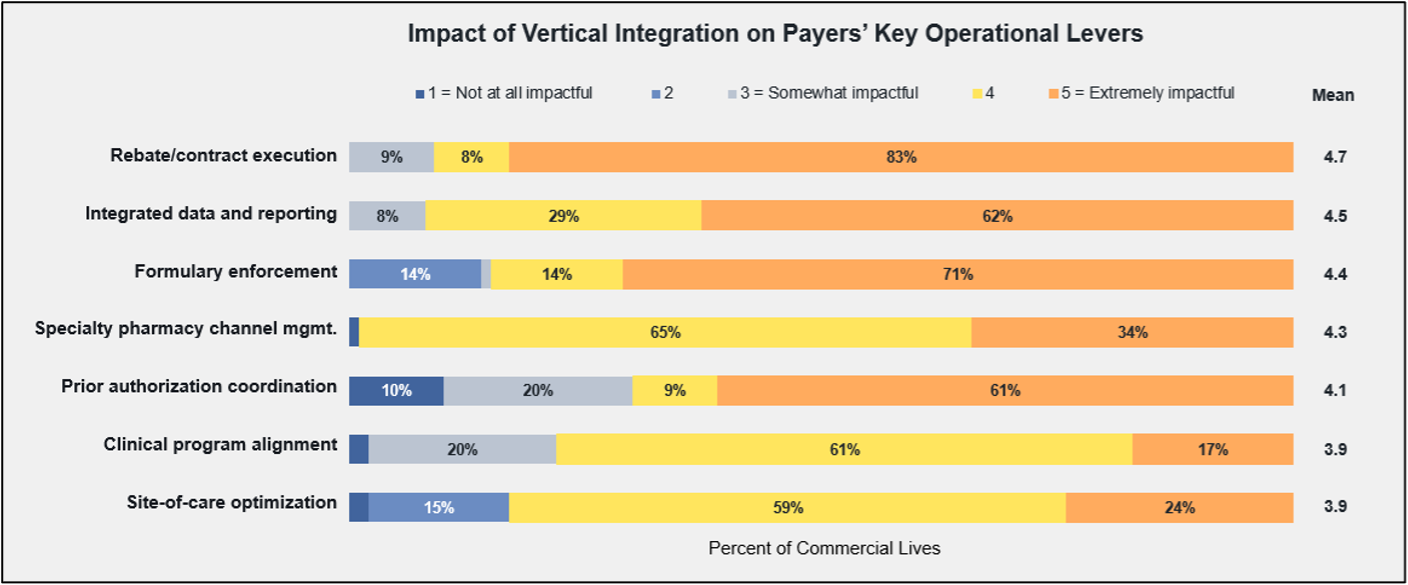
Of course, vertical integration also has its drawbacks for payers. Most integrated payers (89%) cite legal and governmental challenges as the key disadvantage of consolidation — and 93% of payers still researching integration anticipate the same friction. Almost half of integrated payers (49%) also cite decreased provider satisfaction as an organizational challenge resulting from integration, while 44% note decreased patient satisfaction.
Rebates and Exclusivity Are Driving Biosimilar Adoption
So how does vertical integration impact biosimilars? Integrated payers report that net pricing for biosimilars is equally or more predictable post-integration, citing greater control, visibility, and contracting alignment across the value chain.
When payers were asked what actually moves a biosimilar onto formulary, the clinical story took a back seat to the financial one. Payers identify rebate or net price guarantees and formulary exclusivity as the most influential drivers of biosimilar adoption within their organizations, far ahead of other concerns (see chart, below).
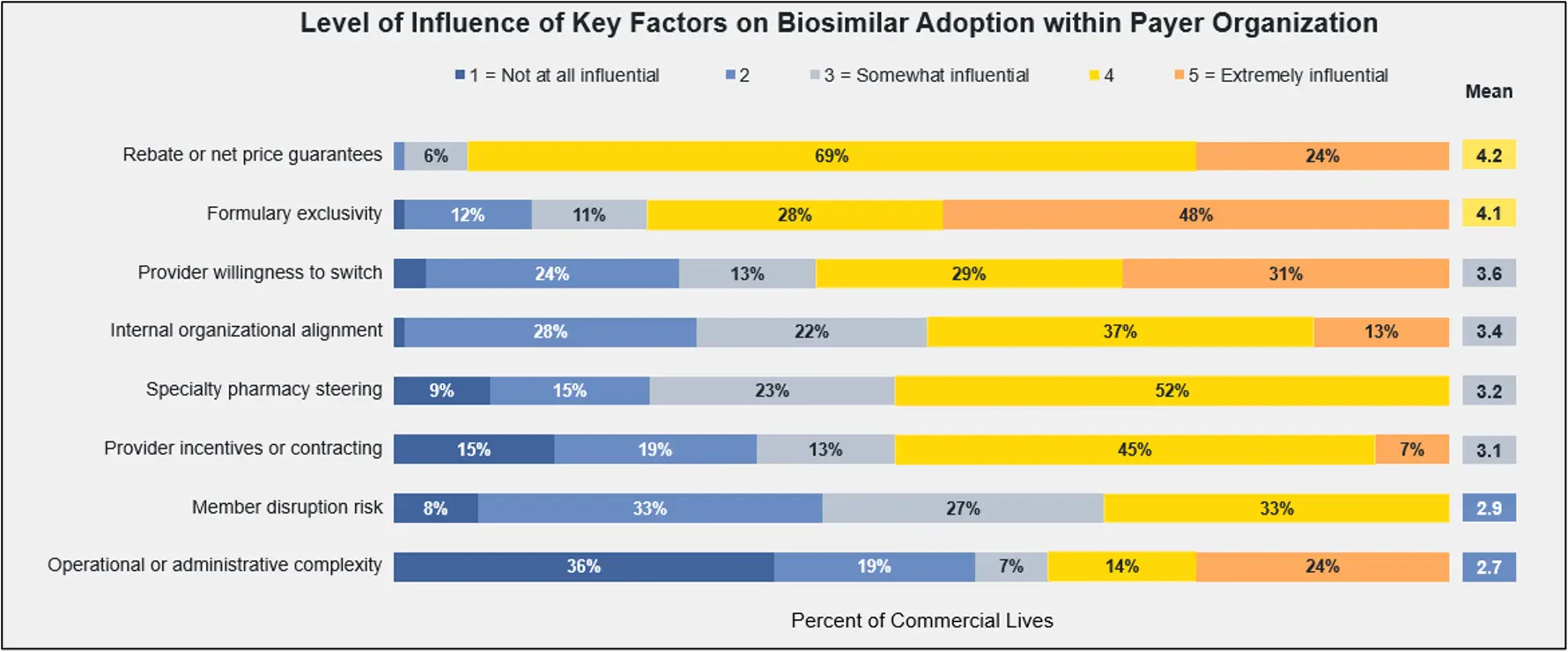
This financially driven adoption pattern is already playing out at the formulary level: 70% of payers say they’re highly likely to remove a reference product from preferred status once a biosimilar enters the market. Among payers who are likely to do this, the top anticipated outcome is net drug cost savings, which rates as much more significant than concerns about member or provider disruption. Biosimilar adoption levels vary by therapeutic area (TA), with immunology and oncology leading current adoption, while neurology and rare disease lag behind.
Payers agree that the TA itself influences whether or not the reference product is able to retain market share. As one payer noted, “It really comes down to how comfortable providers are with switching and how sensitive the condition is to change. In areas like immunology or oncology, where patients are often stable on therapy and outcomes can be more variable, there tends to be more hesitation to switch, which helps the reference product hold share longer.”
However, when assessing whether a biosimilar market will resemble adalimumab—in which Humira retained the majority of its market share early on, despite biosimilar competitors—or the free-fall of Stelara after the arrival of ustekinumab biosimilars, payers did not think clinical sensitivity was a major factor.
Payers agreed that PBM/ private-label biosimilar strategies and exclusivity enforcement are the two strongest predictors of how the market will behave. These factors are ranked ahead of the availability of therapeutic alternatives, the reference manufacturer’s contracting strategy, and the TA’s clinical sensitivity. This finding reinforces a theme running through this research: contracting leverage is increasingly what determines biosimilar winners and losers.
Private-Label Biosimilars Deliver Major Savings for Payers
Perhaps the most structurally significant shift in this data is the rise of PBM private-label biosimilar subsidiaries — think CVS’s Cordavis, Cigna’s Quallent, and Optum’s Nuvaila. Most payers (83%) say they’re very or extremely familiar with these entities, and nearly all report they’ve influenced formulary and contracting decisions to some degree.
As one payer noted, “With private label options, there is often a clearer path to savings and more control over how the product is managed, which makes it easier to justify preferring those products over the reference brand. It also pushes more aggressive contracting decisions and faster shifts in utilization compared to what we saw in the past, since the incentives are more aligned internally.”
Adoption of private-label biosimilars is already mainstream, with 64% of payers including them on their formularies. Among those payers, the results are striking — 86% say these exclusives are a major contributor to savings, and most rank better pricing for the organization as the single most influential factor in the coverage decision.
Looking ahead, payers largely see this as the new normal rather than a passing phase. On average, payers agree that as biosimilar adoption grows, manufacturers will increasingly need to partner with private-label PBM subsidiaries to secure market share. A similar number of payers expect private-label biosimilars to become the standard approach rather than being marketed as branded products.
Interestingly, payers’ top concerns about PBM-owned private-label biosimilars are conflicts of interest and an overall lack of pricing transparency. It’s a reminder that even as payers lean into consolidated contracting for the savings it delivers, they also remain wary of the opacity that can come with vertical integration.
That tension extends to the broader supply chain. All surveyed payers report awareness of pharmaceutical wholesalers like Cencora and McKesson expanding into vertically integrated services, such as specialty drug administration and physician practice management. More than half expect this shift to meaningfully affect their site-of-care policies going forward.
Taken together, this research paints a clear picture: biosimilar success is increasingly a function of contracting architecture, not clinical storytelling. Manufacturers competing for share need a strategy that accounts for consolidated payer-PBM decision-making and a payer base that will quickly replace reference products as soon as credible, cost-effective alternatives exist. At the same time, the persistent concerns around transparency and conflicts of interest suggest an opening for manufacturers who can offer payers clearer, more independently verifiable value — even within an increasingly consolidated system.
Stay ahead of biosimilar and market access trends with the MMIT Biologics & Injectables Index, which delivers quarterly, actionable insights into payer behavior and strategy.