
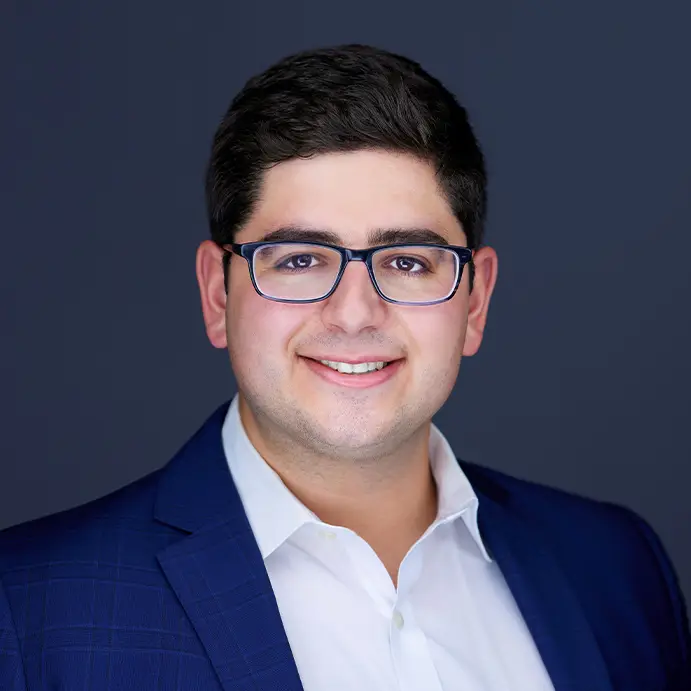
Tell us a little bit more about your role.
MMIT has about a dozen access advisors. I like to think of our team as a kind of data concierge service. When clients come to us with complex questions, we act as the bridge between them and the internal teams who can help. Step one is always figuring out what they really need. From there, we see what’s possible based on the data and tech we have.
We also spend a lot of time helping clients understand how to use our data in a smart and strategic way: making better contracting decisions, launching effective campaigns, and navigating the often overwhelming world of market access.
How did you join the company? What brought you to pharma?
This is a fun story. I was a statistics major at Rutgers, partly because I love sports—especially baseball—and partly because stats opens a lot of doors across industries. After graduating in 2018, I interviewed at a few major NYC banks and immediately felt like just another cog in the machine. It wasn’t the path I wanted.
Then I met someone from Zitter Insights (later acquired by MMIT) at a career fair. In my first interview with Kala Bala, who is still my manager today, we ended up talking about chess because it was on my resume. I’d been playing competitively since I was little and taught chess throughout college. Kala grew up in the same village in Chennai as former world champion Viswanathan Anand. She even knew his wife. I was blown away. Anand is one of my all-time favorite players, and I could probably recite 20 of his games from memory.
Chess has taught me so much—not just how to think ahead, but also that every move has consequences. Kala and I connected right away, and I immediately felt like MMIT would be a place where my voice mattered. I accepted the job on my birthday and never looked back.
Years later, I actually met Anand at a tournament in Switzerland and told him that bonding over his games helped lead me to my career. He got a kick out of that.
What does your day-to-day usually look like?
Most mornings start with a team chat to line up priorities and talk through questions. Around a quarter of my day is spent on client calls, either regular check-ins to keep everything on track, or quick-hit calls to help answer emerging questions—often something specific about Medicaid or Medicare, or a policy nuance they’ve just come across.
Another quarter is spent in internal planning meetings with commercial and clinical partners. We look ahead at upcoming client discussions, align on strategy, and make sure we’re prepared.
The rest of my day is typically focused on client work and projects. I might be enriching indication-level data for a new therapeutic area, analyzing how a new brand stacks up to the competition, or preparing one of our paid deliverables, which offer a deep dive into key fields across large data samples. Every client has different needs, which keeps the work engaging and not repetitive.
What are some of the common challenges of your role?
Sometimes clients need answers yesterday. We do everything we can, but certain limitations just exist, and managing expectations can be tough. Clients are laser-focused on the business need, and understandably so, but sometimes we have to balance that with the realities of data processing and internal timelines.
We’re often the ones in the middle, relaying information back and forth, so communication and honesty are hugely important. We never want to overpromise. While we can’t always deliver instantly, we almost always get clients what they need.
What’s been your career highlight to date?
Norstella has grown through acquisitions, bringing together data from early clinical research all the way through loss of exclusivity. A few years after I started, MMIT acquired Zitter Health and we needed to quickly merge Zitter’s policy and restriction data with MMIT’s formulary data.
I spent a summer working closely with the software development team on a major data migration project. We had to align datasets, create shared definitions, map naming conventions, and make everything work together under intense timelines. It wasn’t easy, but we pulled it off, and the integrated formulary and PAR data we built is still the backbone of what MMIT uses today.
For me, it was an incredible learning experience so early in my career. I’m especially proud of that accomplishment because I know how valuable that merged historical dataset is for our clients.
What industry trends do you see that MMIT is uniquely positioned to help with?
One big area is interpreting coverage for new-to-market products. When a therapy first launches, plans handle it differently: some cover right away, some hold it based on internal review cycles, and others wait to see what competitors do. It can look inconsistent and confusing from the outside.
Because we have strong relationships with payers, we often get the “why” behind those decisions. We can talk to payers, gather their rationale, and translate that back to clients in a simple, actionable way. That transparency is a big part of the value we provide.
Which company principle resonates most with you?
For me: kindness, empathy, and grace. I’m a big believer in the saying, “People may not remember what you said, but they’ll remember how you made them feel.” Everyone has tough days, and our clients face enormous pressure. I try to approach every interaction with empathy and respect, which really goes a long way.
What would you tell someone just starting their career with MMIT?
Be a sponge. Soak up everything. The internal language, the pharma terminology, the endless abbreviations…nobody understands it all in week one, or even month one, and that’s okay. Ask questions, even if you feel like you’re asking them a lot. When I was new, I probably drove people crazy with how many questions I had, but everyone was patient and helpful. I try to pay that forward.
I’d also encourage new hires to be visible—even in a remote world. Turn your camera on. Participate. Don’t quietly coast. There is so much opportunity here, and the people who get the most out of it are the ones who engage.
What do you like most about working at MMIT?
The team, hands down. I’ve had the same manager since 2018, and our dynamic has grown and evolved along with my career. The access advisor team is close-knit, supportive, and curious. There’s no such thing as a dumb question, and that mindset really matters, especially in a remote environment. With a stats background, I could have taken my career in many directions, but the people here are what make me want to stay.
What do you like to do outside of work?
Chess is still a huge part of my life. At least once a week, I hop on a train into NYC to play in a tournament, and I play online constantly. I also travel for bigger events when I can.
I grew up playing sports and I’m extremely competitive. I still play men’s softball, and in the last few years I’ve gotten addicted to pickleball. Oddly enough, it’s a lot like chess—strategy meets patience meets timing. It’s social, great exercise, and just plain fun. I even love the sound of the ball. So if I ever go missing, I’m probably on a pickleball court!
I also recently got engaged in August, and I love traveling and trying out new restaurants with my fiancée whenever we can.
