
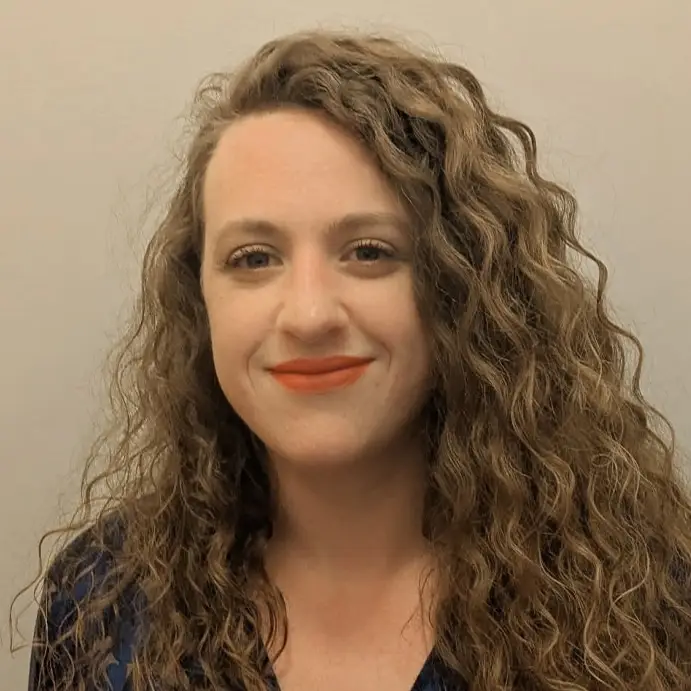
Tell us a little bit more about your role.
I’m a manager of a small three-person team within our larger enterprise access and data expertise (EADE) group. Essentially, we research and align payer coverage, formulary and access and restrictions data from various sources, and that data feeds our Analytics solution as well as any other tool or solution that builds off of our coverage data. We support clients who have questions about the data, and we help them through their larger scale initiatives to upgrade or enhance the way they use their data.
How did you join the company? What in your background brought you to pharma?
I joined the company right out of college, in a temp-to-hire data entry position, which obviously went well! I’ve been here almost 10 years now. At MMIT, particularly in operations and EADE, a lot of people in supervisory and management positions began their careers as temporary employees. It’s nice to see those success stories all around me.
What does your day-to-day usually look like?
My days are generally pretty unpredictable, as how I spend my time is dictated by client needs. I spent part of my week helping to manage my team through their workload and functions, but most of my day is taken up with facilitating client requests. These issues come to us in a variety of ways, such as through our client success managers or our access advisors, who might initiate a series of verifications because a client engaged more deeply with our data.
For example, a client might question the accuracy of the coverage data for one of their products, so we go in and look at our data sources. We will make changes if need be, but most of the time, we just need to explain the intricacies of our methodology and how a particular result is derived. Unfortunately, it’s never clear and transparent, which is why market access as a business exists.
If coverage was not so opaque, anyone could go take a look, and it would be immediately obvious what this health plan was doing with a particular drug. However, that is not the case! And as we can’t give our clients a flow chart that says “Any time you see X, that equates to Y, which always means Z,” we support them by talking through the points of confusion. Is a drug that is not listed on a payer’s formulary covered, or not covered? There are no guarantees, so we take a step back, dive into the data and explain what we find.
Those regular touch points really start to build strong relationships between our clients and our data experts. Clients realize over time that we’re not just firing off answers at them, we’re really thinking about what they need and responding to them individually. If they follow up with us, we’ll set up some time with a dedicated individual who will walk them through these policies and explain them in greater detail if need be.
What are some of the larger projects you’re working on?
I’m working pretty closely with the product team on Searchlight, which is a new tool that provides clients with immediate alerts on relevant coverage changes.
When a payer publishes a new policy update, it is not instantaneously incorporated into our database—nor should it be. Our process involves bringing in various documents, matching the data to the correct plans in our system, and then relying on analysts to incorporate the actual meaning of those documents and clinical guidelines into our data, which then become the solutions purchased by our clients.
However, clients are eager to know what’s coming down the pipeline, and they want to make sure that we’re collecting any new documents ASAP. Searchlight solves this need, because it’s an immediate alerting tool that lets clients know a policy change has happened. They can get a sneak peek at the document and give it a quick review on their own: looks like Cigna added a step for your therapy. After some processing time, the meat of that change will be fully integrated into our solutions, and they’ll be able to compare coverage for their product to other products in that class, etc. But for now? They are satisfied to know that a change has occurred. I like to think of it as providing the movie trailer up front rather than the full film.
We’re coming up on the general adoption phase of Searchlight, where it’s available to any client who wants it and not just our beta clients. We’ll need to make sure that this large product initiative rolls out smoothly and our team is comfortable supporting clients with the new alerting tool and any specific inquiries that come in related to this kind of change-based information.
What are some of the common challenges of your role?
Our day-to-day work is driven by our clients’ changing needs, which means that we have very limited control over how we spend our time. Prioritizing client questions as they come in is a constant challenge, as you might have three clients needing your attention at once for issues of equal weight and import—so which do you handle first?
While we have standard service-level agreement (SLA) time frames for our response, some issues must be expedited due to the immediacy of the issue or client demands. It’s always a balancing act of client needs versus team resources; how much time should we dedicate to Client A’s issue versus Client B’s? Whose issue demands attention first? We make the best calls we can at the time.
What’s been your career highlight to date?
In 2020, I had the opportunity to work with Diane Watson, MMIT’s CEO, to start refining how the company approached data verifications. Back in the day, our team did not engage with clients directly at all. Even if a client had questions—or wasn’t getting what they needed from their data—their feedback was vetted by the CX team. It was a highly siloed process that really wasn’t working anymore as the company scaled up.
Diane and I went into the office on a quiet day and hashed out the ideal process on a whiteboard. How could verifications meet a broader client need, so we weren’t just regurgitating answers but were building client engagement? How do we bring the clients and the data experts together? From that initial discussion, the idea of EADE came about—a data expertise team with a client focus.
We now have access advisors who are really well-informed about the data and also highly keyed into client needs. They know what we can reasonably provide from a data perspective, and they can also come up with creative solutions to bridge a technology gap because they are intimately familiar with our operations and processes. They can lean on this huge team of data experts who dive deep into the nitty gritty data attributes to find what we’re looking for.
While I certainly didn’t come up with all these ideas, I am proud of that initial conversation with Diane. Asking the question about how these different teams could talk to each other rather than constantly past each other helped us move our data experts in the direction of the clients and vice versa. And I’m proud of the part I played in helping us rethink our structure and function.
Which company principle resonates most with you?
Probably the ‘humility, gratitude, and learning’ principle. I think that’s huge, because we actually live it. When so much of your job consists of quick judgment calls, you have to be comfortable with the fact that it’s impossible to make the right call 100% of the time.
The best we can do is to keep learning. If I make the wrong judgment call, I can at least recognize that and incorporate a new parameter to help me make a better decision the next time. There’s no need to get hung up on the fact that I made the wrong call; I just learn from it and move on. I get that ethos from my managers, and I think it’s the right attitude to have. Don’t be dismissive of mistakes, but don’t obsess over them, either – just use them as learning opportunities.
What would you tell someone just starting their career with MMIT?
Absorb as much as you possibly can. In the beginning, a lot of the conversations you’re going to hear won’t make sense to you yet, so it’s really easy to lose focus. nut if you take it all in at face value, even if it doesn’t fully register yet, you’ll begin to internalize that information. And a few weeks down the line, someone else will reference back to that point and it will all start to connect.
Have an open mind. The best thing you can do to prepare for your job is to really listen and observe; read through other people’s emails and comments even when they don’t completely make sense. You’ll eventually feel less out of your depth and elements will begin to click into place.
What do you like most about working at MMIT?
Definitely the people! We have a great camaraderie on this team. I’ve worked with the EADE and operations folks for years, and it’s exciting to get to work with them in a new capacity as they move into different roles. I can look around and see three people that I used to do data entry with, and now they’re experts, each in charge of a different component of our process. It’s very cool to look around and think, “all right, we did pretty well around here, guys!”
What do you like to do outside of work?
I’m a big reader and writer, and I love old movies and history. I watch a lot of lectures on ancient Egypt and Mesopotamia, time periods like that. I like seeing where we’ve come from, and realizing that people haven’t really changed. The human experience fascinates me!
