Nearly four years after the IRA became law, its most closely watched provision is no longer theoretical. CMS-negotiated pricing for the first round of selected high-expenditure Medicare Part D drugs took effect in January 2026. These negotiated prices, referred to as Maximum Fair Prices (MFPs), reflect reductions from 2023 list prices ranging from 38% to 79%.
Payers say they were ready. In MMIT’s Q2 2026 Indices IRA survey, payers representing 74% of Medicare lives reported being well prepared for the January 1 launch. Most payers (representing 69% of Medicare lives) rated their IRA initiatives highly successful, crediting early planning, formulary compliance work and building MFP pricing into benefit and bid design.
But readiness has not meant business as usual. More than half of Medicare payers report weakened negotiating leverage under the IRA’s mandatory formulary coverage requirement for MFP-selected drugs. And all Medicare payers have seen manufacturers offer deeper rebates or expand contracting on at least one non-negotiated drug in response to MFP pricing.
MFPs for the second round of drugs selected for the Medicare Drug Price Negotiation Program (MDPNP) will take effect in January 2027, with pricing reflecting an average 62% discount relative to 2024 list prices. These drugs extend the program into a few new areas, including GLP-1s, oncology, neurology, and respiratory disease.
As we prepare for what’s next, let’s explore the impact of the first round of MFPs on coverage. Our Medicare Drug Price Negotiation: Strategic Coverage Dynamics Report tracks formulary placement and step therapy for the negotiated agents across the Medicare and commercial channels. Its first look at the transition, comparing Q4 2025 to Q1 2026, shows a pattern that is less about the size of the discount and more about what else is on the market.
Lower-Cost Alternatives, Not Discount Size, Drive Coverage Shifts
The report’s central finding is that a negotiated price alone did not predict how payers responded. For many drugs, the availability of generic alternatives and biosimilars influenced formulary placement.
The negotiated discounts themselves vary considerably. Merck’s diabetes medication Januvia had the largest discount among round-1 MDPNP drugs (79% off its 2023 list price), as well as the lowest negotiated price ($113 for a 30-day supply). On the other end of the spectrum, Imbruvica, a BTK inhibitor used to treat blood cancers, saw the smallest discount of 38% off the 2023 list price. The blood thinner Eliquis represents the largest exposure, with roughly 3.9 million Part D enrollees and $18.3 billion in 2023 Part D gross costs.
Despite its steep discount, Januvia’s commercial coverage barely moved in the first quarter after the transition. By contrast, drugs such as Entresto and Stelara, which have a generic alternative and commercially available biosimilars respectively, saw higher rates of exclusion between Q4 2025 and Q1 2026. However, not every agent with an available lower-cost alternative saw major commercial shifts (i.e., Farxiga & Xarelto), which may be due to the brands’ patient access strategies and contracting.
Medicare Coverage Improved for Most Negotiated Drugs
The commercial and Medicare channels moved in opposite directions. In Medicare, coverage changes involving a significant level of Medicare lives tended to be favorable to the drugs in the MDPNP and involve large national carriers. That is partly by design, as drugs included in the MDPNP must be covered by Medicare. In some instances, however, payers may be slow to update formularies.
Three MFP drugs (Enbrel, Stelara and Imbruvica) are now covered on a specialty tier with utilization management. One national Medicare carrier moved Enbrel from Not Covered to Specialty (PA/ST), with a step through non-biologic DMARDs. Another national carrier shifted Stelara from Not Covered to Specialty (PA/ST). Short-acting insulins saw the most dramatic gain, with the rate of covered Medicare lives reaching nearly 100% for Fiasp and Novolog in Q1 2026. (The chart below shows an abridged analysis of blinded agents, grouped by therapeutic area; for the full report, which will be refreshed biannually, contact Advisory Services).
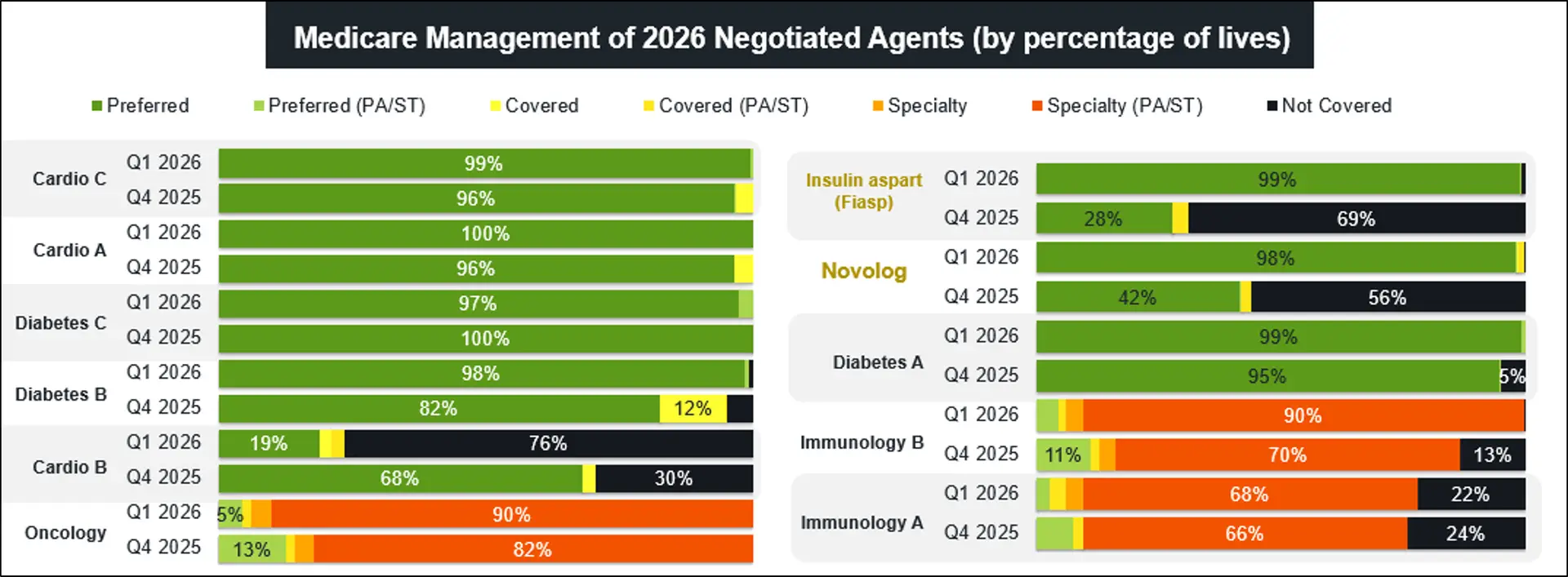
CMS has stated it will monitor formulary designs to ensure access is “meaningful,” not nominal. This mandate has limits, however. While the program applies across all doses and strengths, Medicare Part D coverage does not. Plans must include the negotiated drug on formulary, but they are not obligated to add all dosage strengths and forms; they are only required to have one.
Novartis’s heart-failure medication, Entresto, shows what that means in practice. After generic Entresto tablets (sacubitril/valsartan) became available in July 2025, Entresto Sprinkle capsules became the favored brand dosage form in the Medicare channel, with ~100% of Medicare lives covered for the agent in Q1 2026. Meanwhile, 76% of Medicare lives were excluded from the Entresto tablet in Q1 2026, up from 30% in Q4 2025. As sacubitril/valsartan generics gain traction, the unique sprinkle dosage may keep the brand on the formulary and provide an alternative for patients who have difficulty swallowing a tablet.
Commercial Payers Held Steady, with Targeted Exclusions
In the commercial channel, coverage for MFP drugs either held steady between Q4 2025 and Q1 2026 or changed to a less favorable tier. Despite new wins in the Medicare channel, Stelara experienced coverage losses in the commercial channel. One large national carrier moved Stelara from Preferred to Not Covered across 13 formularies, likely driven by Stelara biosimilars.
Entresto also faced new challenges, as several national commercial carriers excluded the brand, likely driven by the availability of a generic alternative. Exclusion was not the only tool payers deployed; one carrier updated Entresto management from No Step to a single step through its generic, sacubitril-valsartan.
For most of the negotiated drugs, though, commercial coverage simply held steady. Several agents to treat chronic conditions (aside from diabetes) saw stable commercial coverage between November 2025 and January 2026. Many of the largest formularies did not update coverage for these agents immediately in Q1 2026, and some chose to make targeted shifts for only one or two.
Payers’ own assessments match the data. In our Q2 2026 Indices IRA survey, payers representing 80% of commercial lives said the IRA’s mandatory coverage of MFP-selected drugs has not changed their negotiating leverage with manufacturers. Although some payers have renegotiated rebates or restructured manufacturer contracts, most payers describe the IRA as a moderate rather than transformative force on commercial strategy.
GLP-1s Raise the Stakes for the 2027 Cohort
In the Q2 2026 Indices IRA survey, most Medicare payers (representing 74% of lives) said they plan to re-evaluate positioning of the first 10 MFP drugs ahead of 2027. Their focus is on tier placement, prior authorization and preferred status, including removing drugs where generics exist. Commercial payers are more patient: most (representing 63% of commercial lives) have no plans to re-evaluate now.
The second cohort raises the stakes. Payers expect GLP-1 therapies to have the greatest financial impact on both their Medicare and commercial lines of business. And they are signaling how they intend to manage the new selections:
- Payers representing 94% of Medicare lives expect utilization management to channel patients to a lower-cost alternative or generic first, rather than the MFP drug.
- Medicare payers view indication-based prior authorization as the most acceptable control for 2027 MFP drugs.
- Payers representing 92% of Medicare lives are revising 2027 Medicare Advantage bids and Part D premium assumptions for pricing, utilization or cost trends.
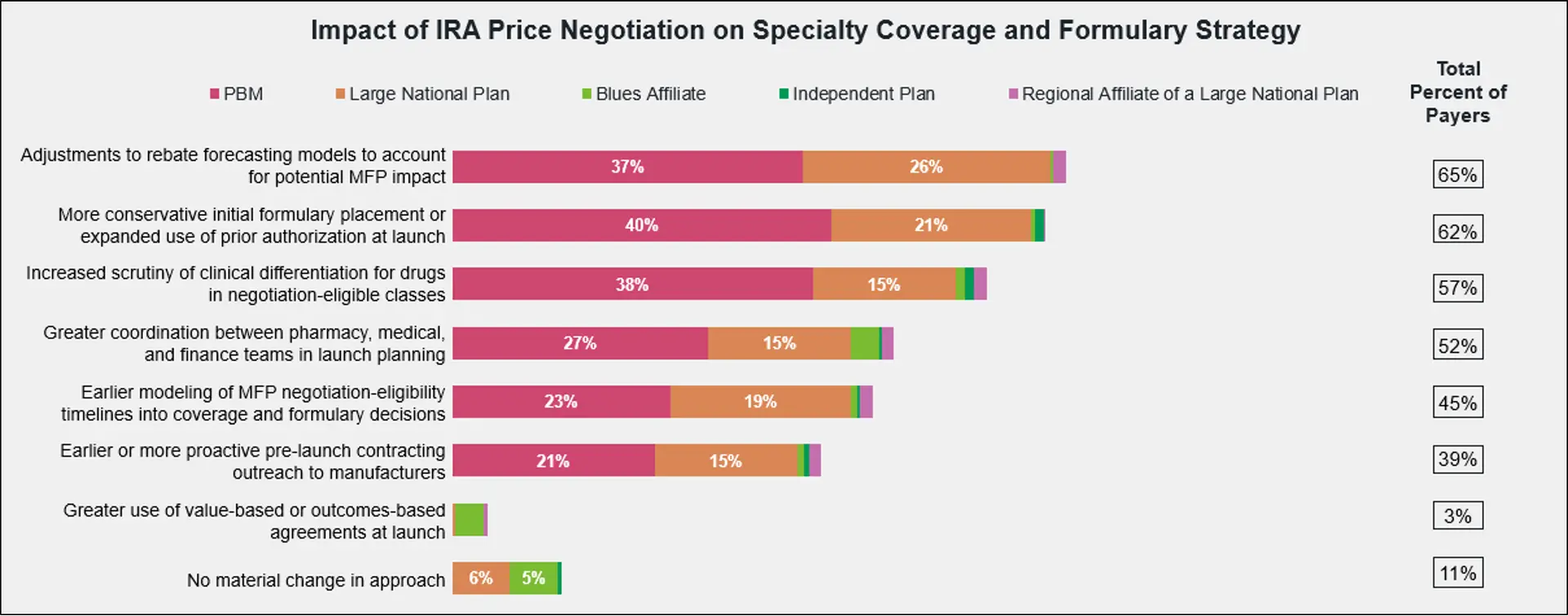
The ripple effects are reaching products that have not been selected at all. Payers report that IRA price negotiation has changed their approach to specialty launches. Most (65%) have adjusted rebate forecasting for potential MFP impact, while 62% have adopted more conservative initial formulary placement. More than half are also scrutinizing clinical differentiation for drugs in negotiation-eligible classes (see chart below).
What Year One Tells Manufacturers About the Next Round
For manufacturers, this early data offers both reassurance and a warning. As the program matures, even drugs with stable coverage, like Januvia, could change as conditions evolve. The availability of lower cost alternatives will also continue to influence formulary placement.
- The program’s impact reaches beyond Medicare. The MDPNP is expected to affect contracting beyond the Medicare channel. Already, payers representing 41% of commercial lives say manufacturers of non-negotiated drugs have adjusted rebate and contracting offers in response to MFP pricing.
- The availability of lower-cost alternatives matters. For many drugs selected for price negotiation, the availability of generic alternatives and biosimilars has a significant influence on formulary placement.
- Access strategy and contracting still make a difference. Farxiga and Xarelto both face lower-cost competition, yet neither saw major commercial shifts. This may be due to the brands’ patient access strategies and contracting.
- Alternative dosage forms can provide staying power. Entresto Sprinkle suggests that brands with alternative dosages and administrations may keep their formulary position if they have generics available and are selected for negotiation.
- Specialty tiers and utilization management persist. Payers may cover agents on a specialty tier with utilization management. Enbrel, Stelara and Imbruvica were managed on specialty drug tiers for a majority of Medicare lives for most of 2026.
The first round of negotiated prices has not upended coverage, but it has made one thing clear: payers are responding less to the size of the discount than to the alternatives on the market. As GLP-1s and other high-impact drugs join the program in 2027, manufacturers that build access and contracting strategies around that reality will be best positioned to protect patient access.
MMIT’s Medicare Drug Price Negotiation Program: Coverage Dynamics Report provides coverage and PAR data trended in six-month intervals, available as a one-time report or a subscription. For the full report featuring February – July 2026 data, contact Advisory Services.