In mid-2025, President Trump reissued an executive order on Most Favored Nation (MFN) drug pricing, which ties U.S. prices for selected drugs to the lowest price paid in comparable developed countries. By November 2025, CMS introduced two mandatory models (GLOBE and GUARD) for participating drugmakers, along with an optional model that makes MFN pricing available to state Medicaid programs via manufacturer rebates.
As the GLOBE model is slated to go into effect on January 1, 2027, health plans and PBMs now must make it work in real contracts and formularies. In September 2026, MMIT surveyed payer organizations about what they expect from MFN policy. Their answers say a lot about what comes next. Payers representing 84% of commercial lives think the MFN approach will likely lower their net drug spend, yet 45% of payers expect their overall pharmacy costs to stay about the same.
Below is a look at where MFN policy stands today, what payers told MMIT, and what it could mean for plans, employers, and manufacturers.
MFN Pricing in 2026: Voluntary Deals Move Fast While Medicare Models Narrow
The current MFN effort is moving forward on two tracks: voluntary agreements with manufacturers and mandatory Medicare models.
The voluntary agreements have moved fastest. By the end of August 2026, 26 manufacturers had signed MFN agreements, and the White House says those companies account for roughly 90% of the branded market. The agreements extend MFN prices to state Medicaid programs and to each company’s new launches. Some of these drugs can also be bought directly, outside of insurance, through TrumpRx, a government website that launched in February 2026.
Tariffs give drugmakers a strong reason to sign. Since July 31, imported patented drugs have faced Section 232 tariffs of up to 100%. Companies that sign both an MFN drug pricing agreement and a U.S. manufacturing pledge are exempt from paying tariffs through January 20, 2029.
On the Medicare side, CMS finalized the GLOBE model for Part B drugs on September 30, 2026. Under GLOBE, manufacturers pay rebates when the Medicare price of certain high-spend drugs exceeds a benchmark built from prices in 19 reference countries. The final rule is far narrower than the proposal. It adds new exclusions, waives the model for manufacturers in GENEROUS (the voluntary Medicaid MFN model), and pushes the first performance year to April 2027.
CMS now expects just four manufacturers to be affected. It also lowered its savings estimate to $440 million, down from $11.9 billion in the proposed rule. GLOBE also applies only to traditional Medicare, not to Medicare Advantage or Part D. GUARD, the companion model for Part D, is still under review at the Office of Management and Budget.
Supporters see MFN pricing as a way to close the gap between what Americans and citizens of other wealthy nations pay for the same medicines. Critics question how much the policy will actually save. The administration’s savings figures haven’t been independently verified, and eight Democratic senators have asked manufacturers to show that MFN prices beat what Medicaid already pays after rebates. The center-right American Action Forum has also argued that the tariffs are more likely to raise drug costs than lower them.
For payers, the stakes go beyond list prices. Lower MFN-based prices can shrink the rebate and fee dollars that flow to plans and PBMs. They can also overlap with Medicare’s negotiated prices, reshuffle net cost rankings on formularies, and add new contracting and reporting work. Manufacturers are also selling some drugs at MFN prices through cash-pay channels that sit outside the pharmacy benefit.
Medicare Payers See More Upside than Commercial Payers
Two weeks before CMS finalized GLOBE, MMIT’s Q3 2026 Index report surveyed payers representing 128.9 million commercial lives and 47.7 million Medicare lives. The Medicare respondents manage Medicare Advantage and Part D business, which GLOBE doesn’t touch, so their Medicare outlook depends on GUARD and the voluntary MFN agreements.
On the commercial side, payers representing 77% of commercial lives expect MFN pricing to have a neutral effect on their business, with only 14% expecting a positive effect. Medicare insurers are more hopeful, with payers representing 48% of Medicare lives expecting a positive impact on their business.
Payers expecting gains mostly point to cheaper high-cost specialty drugs and biologics. “MFN drug pricing should generally apply downward pressure on high-cost drugs,” said one Blues plan, while a large national payer noted that MFN should bring down WAC and, in turn, net prices.
Payers Expect Lower Drug Spend, But Flat Pharmacy Costs
Overall, payers are fairly confident that MFN pricing will push net drug spend down. Payers covering 84% of commercial lives say lower drug spend is likely, with many also expecting reduced manufacturer rebate and remuneration dollars. Lower Part D net drug spend is also the most anticipated effect of MFN pricing on Medicare books, expected by payers covering 58% of Medicare lives; formulary tier placement changes are the least likely.
Total pharmacy costs are another story. Only a third of payers (32%) expect MFN to decrease their organizations’ overall pharmacy costs; these payers are primarily Blues and regional plans, along with one main national plan. Almost half of payers (45%) expect no change to their overall pharmacy costs; these payers are led by the large PBMs, and represent roughly two-thirds of total lives.
Every payer expecting savings said they would come from lower manufacturer pricing or reduced net cost per claim. The catch is that rebates shrink as list prices fall. One Blues plan noted that they expect costs to fall “very modestly,” with savings “partially offset by reduced rebates and contracting changes.”
Rebate Erosion Is Payers’ Top MFN Concern
If one theme ties the survey together, it’s rebate erosion. Payers covering 49% of total lives expect rebates and other manufacturer payments to fall once MFN pricing takes effect. Rebate erosion also ranked highest among the challenges payers expect from MFN pricing.
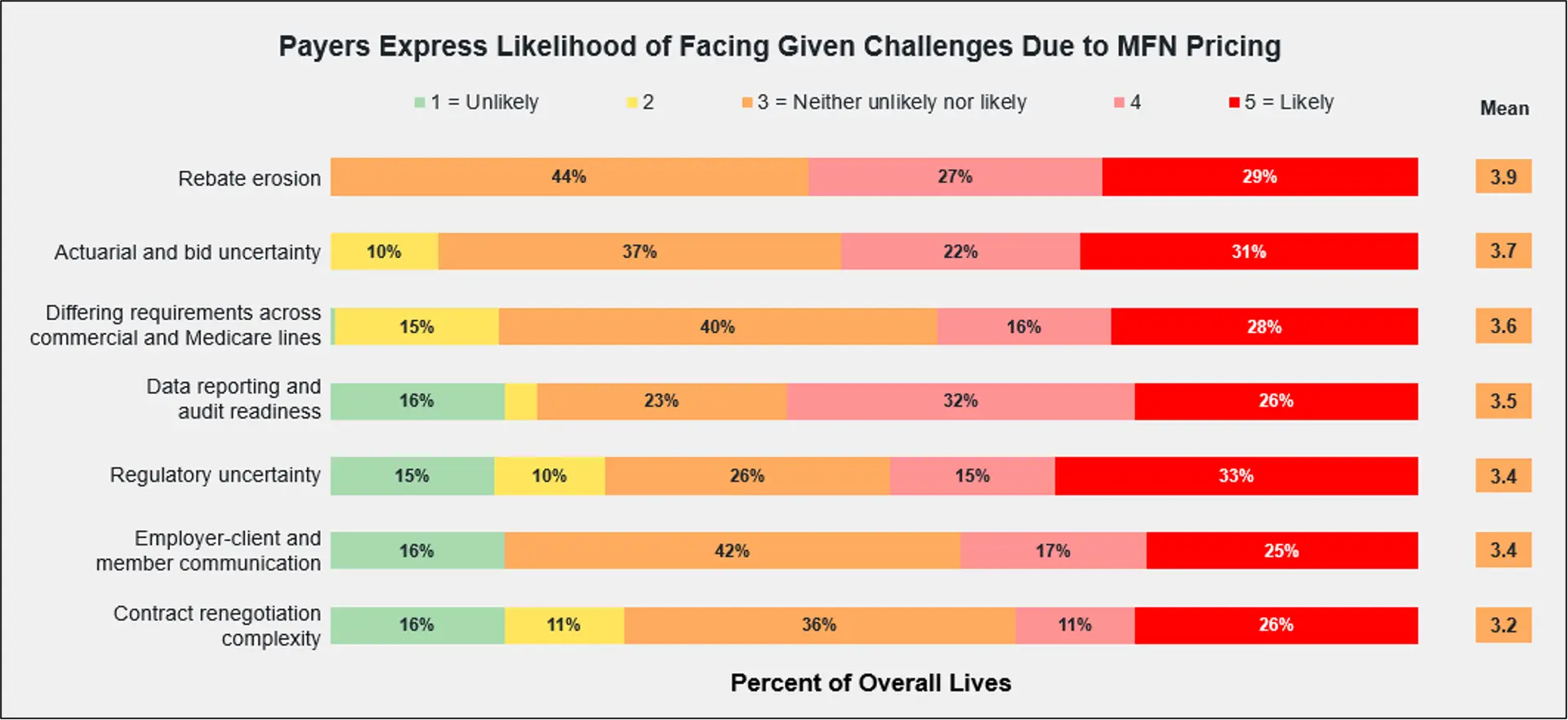
When list prices move toward an international benchmark, the gap between list and net cost narrows, and rebates live in that gap. One payer shared concerns that gross and net costs will become more similar for plan sponsors, which could hurt organizations that rely on rebates. Another payer described it as a move away from “a rebate-driven model toward one that is much more focused on the actual net cost of the drug.”
That shift is already showing up in contracting plans. Over 70% of all payers surveyed say they are likely to reassess their manufacturer or PBM contracting strategy. On the commercial side, payers covering 54% of commercial lives expect contract renegotiation; a similar cohort also expect changes to employer pricing guarantees and more employer-client reporting and questions.
Some organizations feel insulated from MFN-driven changes. One payer said it will offer sponsors a rebate-free option beginning in 2028, while another said a drop in rebates isn’t a concern because it doesn’t require them.
Net Cost Takes the Lead in Formulary Decisions
Formulary strategy is where payers expect the clearest change. An increased preference for lower-net-cost alternatives is the most likely formulary shift under MFN, according to payers covering 73% of total lives.
Biosimilars stand to gain too. Payers covering 52% of total lives expect a stronger formulary preference for biosimilars, and 44% expect biosimilar adoption to rise. Payers covering 40% of total lives also expect commercial and Medicare formularies to drift apart. One payer described how that could happen when a brand carries an MFN price in Medicare but costs more on the commercial side.
Payers are divided on whether utilization management will be impacted by MFN. Payers representing 32% of total lives expect more restrictive UM overall, while payers representing 46% of lives do not. However, payers covering 52% of total lives do expect more restrictive prior authorization requirements, and 43% expect more restrictive step therapy requirements. Only payers covering 26% of total lives expect to relax management where net cost declines.
Specialty Access and DTC Channels: Little Disruption Expected, for Now
In the near term, at least, most payers (52%) don’t expect MFN pricing to change patients’ access to specialty drugs. Some payers say it’s too early to tell, while others note that it will likely depend on the therapy or class. In classes where prices drop meaningfully, some payers say they could see broader access or less restrictive utilization management.
Manufacturer direct-to-consumer offers priced at MFN levels aren’t seen as a threat to the pharmacy benefit either. No payer expects a meaningful shift of volume outside the benefit. About four in ten payers (39%) expect a limited shift, but they cover only around 12% of total lives. As one payer explains, so far, the drugs offered at MFN prices are mostly “mature brands” that are “not materially impactful.”
What Manufacturers Should Do Now
For now, payers expect MFN pricing to reshape their economics gradually. While lower drug prices look likely, the potential for lower total costs is less certain. Most organizations still have work to do before they can capture whatever savings arrive. According to our research, few payers feel fully prepared to operationalize MFN pricing changes, and 35% of payers (representing 40% of covered lives) still need additional investment or resources.
MFN pricing won’t hit every brand the same way, but the survey points to the same pressure on all of them: payers are moving from a rebate-driven model to one built on net cost. Manufacturers can get ahead of that shift in four ways:
- Stress-test your contracts. More than 70% of payers say they’re likely to reassess their manufacturer or PBM contracting strategy, and payers covering 54% of commercial lives expect renegotiation. Model how your rebate position holds up if list prices move toward an international benchmark.
- Compete on net cost, not rebate size. With payers covering 73% of lives expecting a stronger preference for lower-net-cost alternatives, brands that win on rebates alone are the most exposed.
- Plan for diverging Medicare and commercial formularies. Payers covering 40% of lives expect them to drift apart, and 52% expect tighter prior authorization. Build market access and field strategies by channel, not by brand.
- Watch the biosimilar landscape. With 52% of lives expecting a stronger formulary preference for biosimilars, reference products should be ready to defend their position.
Change will likely be gradual rather than abrupt. As payers are still building the capacity to operationalize MFN pricing, manufacturers can expect contract renegotiations, new reporting requests, and employer questions to arrive in waves through 2027 and beyond. Near-term access and DTC dynamics look stable, but manufacturers who understand how each payer segment is recalibrating around net cost will be best positioned when MFN policy takes full effect.
Learn more about our Indices solutions, which provide access insights from leading payer stakeholders representing 75% of Commercial and Medicare lives.