Pharma manufacturers invest significant time and money developing resources for payers, from budget impact models to PIE packages and NCCN summaries. But are those resources hitting the mark?
New Q1 2026 MMIT Indices research, surveying commercial payers representing more than 126 million covered lives and Medicare plans representing 50 million lives, offers a few insights. The findings reveal not just what payers say they want, but where most manufacturer-provided materials still fall short.
On the clinical side, payers want detailed efficacy data, plus comparative differentiators and real-world evidence. On the financial side, they want more cost-effectiveness data and transparent budget impact models. Most importantly, they want all of these elements delivered simply and concisely, with greater transparency. Let’s take a look at our research results.
Clinical and Comparative Data Ranked Most Valuable
When it comes to formulary decision-making, efficacy and safety evidence remain the primary driver aside from cost. A close second is comparative performance data, which reflects the growing importance of head‑to‑head data and robust differentiation strategies in market access.
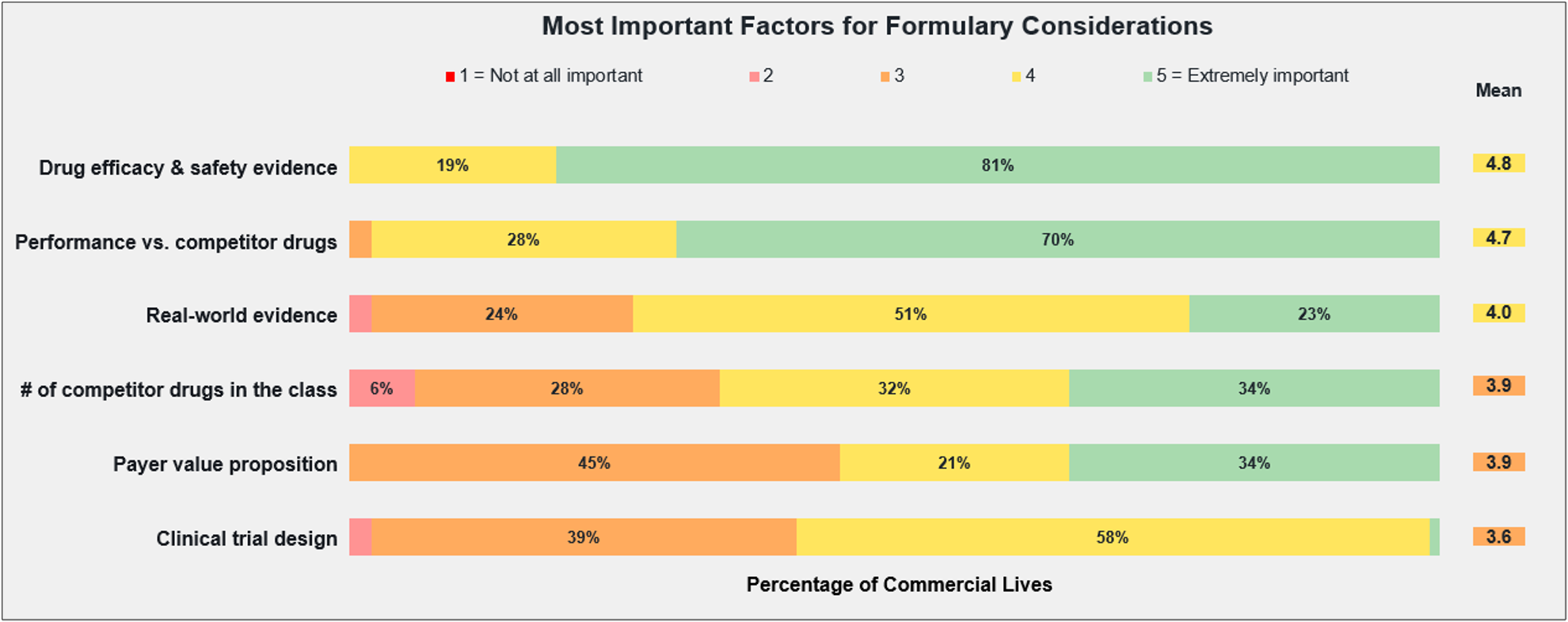
The least influential drivers of formulary decisions include mechanism of action, pre-approval information exchange (PIE) decks, and dosage information, indicating that payers deprioritize factors that do not directly demonstrate clinical value or patient impact. This hierarchy carries an important implication: payers are less interested in hearing a story about how a drug works. Instead, they want a clear, quantified answer about how well a drug performs relative to the drugs they’re already covering.
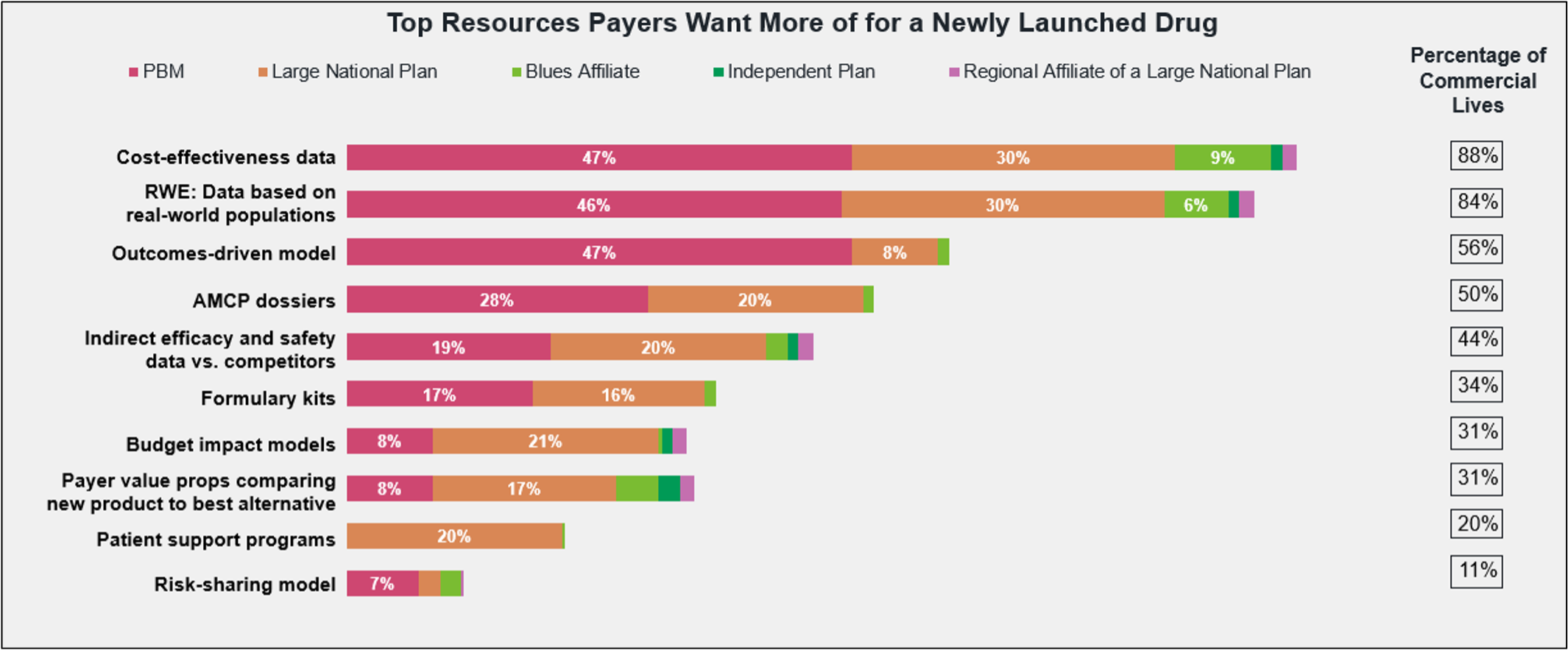
That comparative lens extends to the most-requested resources regarding newly launched drugs. One data point stands out in particular: 88% of payers say they want manufacturers to provide more cost-effectiveness data, suggesting that there is a large unfilled gap in what manufacturers are currently providing. In addition, payers representing 84% of commercial lives also request more real‑world evidence based on broader patient populations.
Timely PIE Decks Offer Early Clarity on Indication and Predicted Utilization
In 2022, the Pre-Approval Information Exchange (PIE) Act was passed into law, allowing anufacturers to share clinical and health economic information with payers before FDA approval. Payers representing 49% of commercial lives find PIE presentations to be very or extremely useful for pre-launch planning. More payers (44%) prefer to receive PIE information 3–6 months before approval than 6-12 months out (36%), indicating a desire for timely (but not premature) pre‑launch insights.
What do payers want most from these exchanges? The top answer is early clarity on anticipated indication and labeling expectations. Payers rank comparative clinical data as the second-most important information they seek from PIE, followed by predicted utilization and forecasts of the eligible patient population.
Payers representing 78% of commercial lives are also interested in a manufacturer’s plans for real-world evidence, while a similar number of payers are interested in the clinical trial’s design and endpoints. Operational details—like dosing, administration, and expected launch timing—rank at the bottom of PIE importance scores.
Payer Value Propositions Should Enable Comparative Assessments
When asked about payer value propositions (PVPs), those manufacturer-developed summaries that highlight a therapy’s clinical, economic and patient outcomes benefits for payers, our survey respondents generally viewed them as moderately clear and actionable. All payers find PVPs at least slightly useful, and over one‑third rate them as very or extremely useful.
Payers place the greatest importance on the clinical components of a PVP, particularly on evidence of a drug’s efficacy, safety, and differentiation from the standard of care. Economic elements play a secondary role, while a drug’s health equity impact, administrative burden reduction, and operational considerations are the lowest‑priority PVP elements for payers.
In fact, the top PVP elements sought by payers are all elements that directly shape payers’ comparative value assessment for that drug: Magnitude of clinical benefit, clear statement of clinical differentiation, total cost of care implications, and budget impact models.
The Case for Third-Party Validated Budget Impact Models
If there’s one tool that has achieved true saturation among payer decision-makers, it’s the budget impact model. Ninety-seven percent of respondents indicate BIMs have at least some value to their organization, and 87% actively use them to compare products within a class. More than 60% also rely on BIMs to inform prior authorization and step therapy requirements.
But high utilization doesn’t automatically translate to high quality. When payers articulate what they need from a BIM, two elements dominate: cost comparisons versus alternatives and clear definition of the target population. Transparent model assumptions and cost offset data follow. The lowest-rated element is the BIM’s ease of use or the ability to run scenarios—which runs counter to the interactive dashboard trend that has taken hold among many medical affairs teams.
The validation question also deserves attention. While most payers have no strong preference for how a BIM is developed, 34% strongly prefer third-party development or validation. Given that payer trust in manufacturer-provided financial and clinical information is closely tied to the use of credible external sources—which ranked as the second most influential trust driver—there’s a compelling case for third-party validation as a differentiating investment, rather than a nice-to-have.
Payers Prefer Evidence-First Formats Without Promotional Spin
In terms of financial impact data, payers place the highest importance on receiving clear acquisition, administration, and total cost‑of‑care information. Also, payers are unambiguous about how they want financial impact information delivered: clear, concise executive summaries are rated as extremely important by 63% of respondents. This preference for brevity and clarity over comprehensiveness is consistent across the research. Detailed BIMs, interactive dashboards, and scenario tools score meaningfully lower on the format preference scale.
In fact, when payers were asked how they want to receive information on new drugs, most said they strongly prefer evidence‑driven and discussion‑based formats. Published literature and virtual meetings are the top choices at 68% and 67%, respectively, with face-to-face meetings close behind at 64%. Visual and promotional formats like interactive materials (37%), videos (27%), and infographics (14%) are far less popular. The takeaway is not that visuals have no place, but that payers primarily want evidence they can read and evaluate independently—not a curated narrative delivered through graphic design.
The Trust Equation: Three Factors That Determine Credibility
Responsiveness to payer questions, use of credible external data sources, and transparency of assumptions are the top three drivers of trust in manufacturer-provided information, each scoring around 4.0 to 4.3 on a five-point scale. What ties these factors together is a common thread: they’re all about whether payers can verify what they’re being told.
Consistency of information over time also scores highly, which is notable for manufacturers whose messaging evolves as a product moves through its lifecycle. When the story changes at every touchpoint, trust erodes. Adherence to PIE and AMCP guidelines ranks last among the trust factors, suggesting that payers are less swayed by process compliance than by the substance of the information.
The implications for manufacturer field teams are significant. When payers ask questions, the speed and quality of a manufacturer’s response is itself a signal. Preparing teams to handle detailed P&T-style inquiries before a product reaches the committee may be as important as the dossier itself.
Overall, our Q1 research makes clear that payers have consistent, well-defined needs that manufacturers continue to underserve. Payers’ preference for evidence-first formats reinforces a broader reality: payers are sophisticated evaluators, and they expect to draw their own conclusions. The goal of manufacturer resources should be to ensure that all data is accurate, accessible, and easy to interrogate.
Stay ahead of payer trends with our Biologics & Injectables Index and Oncology Index, which offer actionable insights on payer preferences and market developments.